
NR509 Week 7 Assignment: Physical Examination Video Evaluation
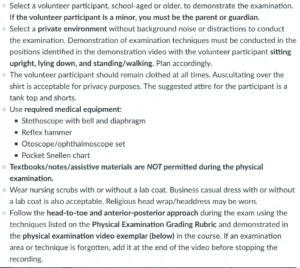
This script will guide you on how to record the Kaltura video assignment for Week 7. It includes all the physical assessment activities that you should conduct.
- Select a volunteer participant, school-aged or older, to demonstrate the examination. If the volunteer participant is a minor, you must be the parent or guardian.
- Select a private environment without background noise or distractions to conduct the examination. Demonstration of examination techniques must be conducted in the positions identified in the demonstration video with the volunteer participant sitting upright, lying down, and standing/walking. Plan accordingly.
- The volunteer participant should remain clothed at all times. Auscultating over the shirt is acceptable for privacy purposes. The suggested attire for the participant is a tank top and shorts.
- Use required medical equipment:
- Stethoscope with bell and diaphragm
- Reflex hammer
- Otoscope/ophthalmoscope set
- Pocket Snellen chart
- Textbooks/notes/assistive materials are NOT permitted during the physical examination.
- Wear nursing scrubs with or without a lab coat. Business casual dress with or without a lab coat is also acceptable. Religious head wrap/headdress may be worn.
- Follow the head-to-toe and anterior-posterior approach during the exam using the techniques listed on the Physical Examination Grading Rubric and demonstrated in the physical examination video exemplar (below) in the course. If an examination area or technique is forgotten, add it at the end of the video before stopping the recording.
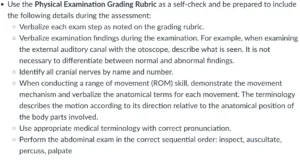
- Use the Physical Examination Grading Rubric as a self-check and be prepared to include the following details during the assessment:
- Verbalize each exam step as noted on the grading rubric.
- Verbalize examination findings during the examination. For example, when examining the external auditory canal with the otoscope, describe what is seen. It is not necessary to differentiate between normal and abnormal findings.
- Identify all cranial nerves by name and number.
- When conducting a range of movement (ROM) skill, demonstrate the movement mechanism and verbalize the anatomical terms for each movement. The terminology describes the motion according to its direction relative to the anatomical position of the body parts involved.
- Use appropriate medical terminology with correct pronunciation.
- Perform the abdominal exam in the correct sequential order: inspect, auscultate, percuss, palpate
SOLUTION
Student:
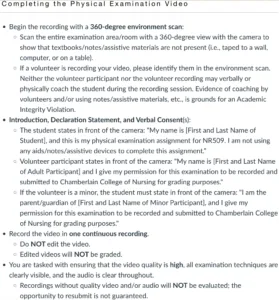
“My name is [First and Last Name] and this is my physical examination assignment for NR509.”
Volunteer Participant:
“My name is [First and Last Name of Adult Participant], and I give my permission for this examination to be recorded and submitted to Chamberlain College of Nursing for grading purposes.”
Environment Scan:
[360-degree camera scan of the examination room to confirm no notes, materials, or coaching.]
Introduction:
“Hello, [Participant’s Name], my name is [First and Last Name], and I will be conducting your physical examination today. The exam will include a head-to-toe assessment and should take about 30 minutes. If at any point you feel uncomfortable, please let me know.”
HEAD AND FACE
- Inspection of the head and face:
- “I will begin by inspecting your head and face. Your head is midline and symmetrical, with no visible lesions or abnormalities.”
- Palpation of lymph nodes:
- “Now, I will palpate the lymph nodes.”
- Preauricular, postauricular, occipital, tonsillar, submandibular, submental, anterior cervical, posterior cervical, and supraclavicular.
- “The lymph nodes are non-tender, without enlargement.”……………………………………..purchase this entire assignment at $15 only
- “Now, I will palpate the lymph nodes.”
Reviews
There are no reviews yet.