

NSG 3543 Exam 1 – The University of Tulsa
NSG 3543 Exam 1
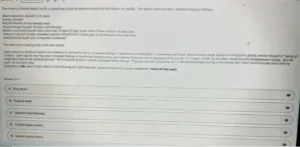
The nurse in a mental health facility is assessing a client to determine potential risk factors for suicide. The client’s chart includes a medical history as follows:
Major depressive disorder X 20 years
Anxiety disorder
Suicide ideation during teenage years
Psychotherapy for past 10 years with therapist
Mother committed suicide when client was 25 years of age; father died of heart disease 10 years ago
History of alcohol misuse, attended in-patient rehabilitation 4 years ago, no alcohol use since that time
Good physical health with no reported comorbidities
The most recent nursing note in the chart states:
Client reports to facility on advice from therapist to self-admit due to increased feelings of depression and thoughts of committing self-harm. Reports having large supply of amitriptyline (Elavil), and has thought of “taking all of them.” Client reports that he has increased feelings of loneliness, hopelessness, and sadness following recent separation from partner of 25 years. States he has been compliant with antidepressant therapy, “But the meds don’t seem to be working anymore.” No immediate family in vicinity, estranged from siblings, “They got over me a long time ago.” Client acknowledges having a few friends, but “I don’t want to burden them with my stuff. I’m not worth that.”
According to this client’s chart, which of the following are significant risk factors for potential suicide completion? Select all that apply.
Answers: A – F
✅ A. Drug abuse
B. Physical health
C. Long term psychotherapy
✅ D. Current support system
✅ E. Access to lethal means
The nurse is caring for a 29-year-old client diagnosed with Major Depressive Disorder, returns to the clinic two weeks after starting sertraline (Zoloft) 50 mg daily. The client reports feeling discouraged, stating, “I’ve been taking the medication like I’m supposed to, but I don’t feel any better. I still feel low and tired, and I’m not sleeping well. Maybe it’s not working.”
Which of the following nurse responses demonstrates the most appropriate clinical judgment and therapeutic communication?
Answers: A – D
A. “Let’s ask the provider to change your prescription since you’re not seeing results yet.”
B. “You need to focus more on therapy—medication is only part of the treatment.”
C. “It’s okay to stop taking it if this medication is not working for you.”
✅ D. “You may not feel the full effects for a few more weeks. Let’s keep monitoring your progress.”
A client is admitted with post-traumatic stress disorder following a fire in his home in which family members died. Which of the following should the nurse recognize as an adaptive defense mechanism?
Answers: A – D
A. The client makes a decision to avoid all future family gatherings
✅ B. The client begins reading a book when he experiences hand tremors in response to loud noise
C. The client refuses to talk about the event with any healthcare providers
D. The client reports he started drinking alcohol again after the event, despite having 2 years of sobriety
The nurse is teaching a student about SSRI antidepressants. The nurse knows the student understands the medication when the student verbalizes fluoxetine (Prozac) and paroxetine (Paxil), are given in the morning for which following reasons?
Answers: A – D
A. They may cause indigestion with meals
B. They may increase blood pressure levels
✅ C. They have a stimulant effect that may interfere with sleep
D. They are slower to act than tricyclics
The nurse is leading a crisis intervention group and asks participants to identify physical signs associated with the body’s initial response to acute stress. Which combination of signs and symptoms best reflects the physiological changes that occur during the initial stage of the stress response?
Answers: A – D
A. Constricted pupils, increased tearing, and hypotension
B. Increased lacrimal secretions, exhaustion, and increased gastric motility
C. Auditory hallucinations, exhaustion, and pupil constriction
✅ D. Increased respiratory rate, increased heart rate, diaphoresis, and reduced gastric motility………………….purchase all the 52 exam questions and answers at $30 only
Reviews
There are no reviews yet.