
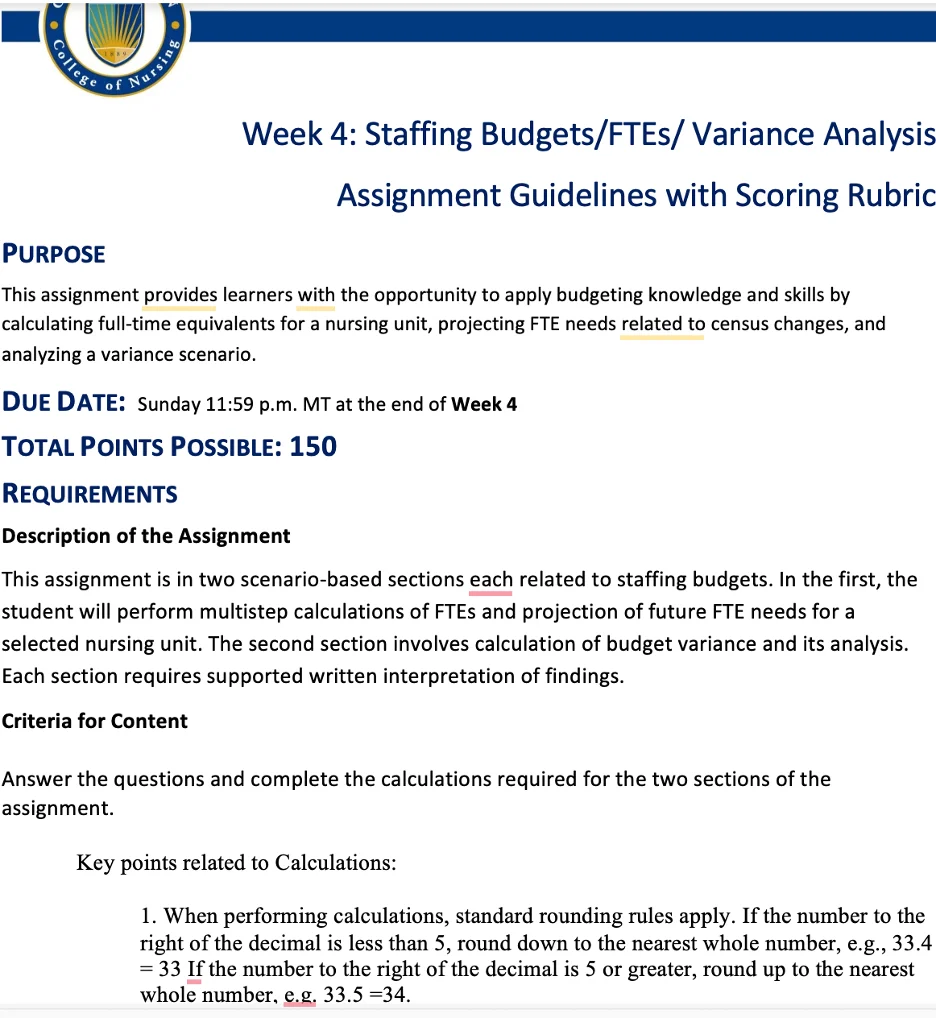
NR533 Week 4: Staffing Budgets/FTEs/Variance Analysis Assignment V3
Description of the Assignment
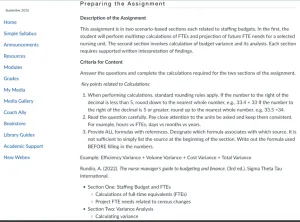
This assignment is in two scenario-based sections each related to staffing budgets. In the first, the student will perform multistep calculations of FTEs and projection of future FTE needs for a selected nursing unit. The second section involves calculation of budget variance and its analysis. Each section requires supported written interpretation of findings.
Criteria for Content
Answer the questions and complete the calculations required for the two sections of the assignment.
Key points related to Calculations:
- When performing calculations, standard rounding rules apply. If the number to the right of the decimal is less than 5, round down to the nearest whole number, e.g., 33.4 = 33 If the number to the right of the decimal is 5 or greater, round up to the nearest whole number, e.g. 33.5 =34.
- Read the question carefully. Pay close attention to the units be asked and keep them consistent. For example, hours vs FTEs; days vs months vs years.
- Provide ALL formulas with references. Designate which formula associates with which source. It is not sufficient to simply list the source at the beginning of the section. Write out the formula used BEFORE filling in the numbers.
Example: Efficiency Variance + Volume Variance + Cost Variance = Total Variance
Rundio, A. (2022). The nurse manager’s guide to budgeting and finance. (3rd ed.). Sigma Theta Tau International.
- Section One: Staffing Budget and FTEs
- Calculations of full-time equivalents (FTEs)
- Project FTE needs related to census changes
- Section Two: Variance Analysis
- Calculating variance
- Variance analysis with explanation
Download the Assignment Word Document and submit your answers directly onto the form. When completed, upload into the assignment portal in your course. For the questions requiring a written response, please adhere to proper grammar and syntax, and provide references. For the questions requiring calculations, show all your work including the formula used. Include the references for formula chosen.
SOLUTION
Section One—Staffing Budget and FTEs
Personnel Budget Case Study
Sandra Chambers has recently accepted the position of assistant administrator for the department of nursing at Potter Regional Medical Center where she will oversee the operations of five medical units. As she evaluates the budgets for the different cost centers, she finds that all are being used at near or full capacity. The activity in four of the five has remained steady over the past 2 years. A fifth unit has realized a steady increase in patient volume during that time and is currently at 88% capacity. It has been projected that within the next 12 months the volume of patients moving through that unit will increase by 20%. Sandra needs to determine if the current FTEs for the unit will be sufficient to ensure quality and safe care continues to be provided, and if not, what is the number of FTEs that will be needed to cover a 20% increase in volume.
- Suggest all the information Sandra needs to collect in order to project the FTEs needed for the next fiscal year accounting for the projected increased capacity. Remember, she is new to her position so be sure to include background data on the unit itself as it relates to previous budgets, nursing staff, and the organization. In other words, summarize your approach to this Case Study.
FTEs info is crucial to managers because it assists them in determining the capacity in units required to extend services at a healthcare facility. In this respect, it is vital to comprehend the volume. This is due to the fact that an increment in volume is directly proportionate to the rise in costs and income. For this reason, FTEs is critical in the facilitation of capacity planning and expansion of services. In terms of FTEs calculation, the essential info required by Sandra Chambers encompasses; budgets developed in the past financial period, the existing and potential full capacity of the medical center, and trend of activities for the past 2 to 5 years. Further, Sandra…
- Calculate the number of FTEs needed for the Unit. Show the formulas used and all calculations. Include the reference used for your calculations at the beginning of your work.
D is the unit with an 88% occupancy rate the compilations of FTEs are founded on FTE to showcase the amount of work hours executed by a single full-time employee in a certain period. It could be a month or a year. In conducting the existing FTE compilation, the standard number of annual hours in 52 weeks measures at 2080 (8*5*52 weeks; these are the fixed and recommended yearly hours).
The aggregate monthly hours: (2080/12 = 173.33)…………………………………..purchase this entire assignment solution at $20 only

Reviews
There are no reviews yet.