
D344 Diagnostic process of psychiatric Nurse practitioner practice (Objective Assessment)
1.
A 60-year-old patient with schizophrenia has continuing mental healthcare with a nurse practitioner (NP). The patient has taken antipsychotics since young adulthood and is currently stable. The patient is at risk for falls related to the patient’s age and taking the antipsychotics.
What should the NP do to prevent falls?
- Recommend resistance training ✅
- Discontinue the antipsychotics
- Change to another antipsychotic
- Recommend social activities
2.
A nurse practitioner (NP) sees a 22-year-old patient currently in college. The patient reports feeling depressed, feeling isolated from others, having low motivation, and not seeking any social activities. The NP wants to address these symptoms with a short-term, focused treatment for depressive symptoms aimed at working on relationships with others and improving social functioning.
Which therapeutic treatment modality should the NP choose to achieve those goals?
- Psychoanalytic therapy
- Interpersonal therapy ✅
- Humanistic-existential therapy
- Cognitive behavioral therapy
3.
A parent brings a young child to a nurse practitioner (NP) and reports that when the parent leaves for work daily, the child appears indifferent to the parent’s departure, and when the parent returns, the child turns away and ignores the parent. The parent is concerned that the child and parent are not bonding well and turns to the NP for guidance. The NP recognizes that the child is demonstrating avoidant behavior towards the parent, according to Bowlby’s attachment theory.
Which approach with the child will help in the reduction of this behavior and develop healthy attachment styles?
- Maintain a strict environment
- Respond in a supportive manner ✅
- Encourage self-soothing habits
- Focus on independence
4.
A 35-year-old patient is being treated for depression with only an antidepressant medication after expressing disbelief in psychotherapy. The patient does not want to stop smoking. The nurse practitioner (NP) makes a note for future smoking cessation interventions to be based on a biomedical model.
What is this stage of change for smoking cessation?
- Precontemplation ✅
- Preparation
- Maintenance
- Contemplation
5.
A nurse practitioner (NP) sees a patient for a follow-up visit for a dual diagnosis of major depressive disorder and substance use disorder. At the previous visit, the NP discussed the impact the patient’s substance use has on their treatment for depression. At today’s visit, the patient acknowledges that drug use is holding them back, but the patient is not ready to do anything about it.
Which treatment approach should the NP employ to assist in moving the patient into the next stage of change when considering the transtheoretical model?
- Assist with the regulation of emotions
- Express empathy and deal with resistance ✅
- Challenge the patient’s cognitive distortions
- Analyze past trauma that the patient had
53.
A patient with a history of traumatic abandonment issues with their parent regularly sees a nurse practitioner (NP) for depression and anxiety. The patient tells the NP that disappointment occurs every time they think they are getting close to forming a relationship with their parent. The parent starts yelling with anger and pulls away. The patient is hurt and upset but is afraid to express their feelings to the parent.
Which tool should this NP suggest to empower the patient’s self-efficacy with the parent?
- Process feelings in therapy
- Sublimate feelings into exercise
- Role-play the conversation ✅
- Encourage talking to the parent
54.
A nurse practitioner (NP) knows that early adoption of effective self-management strategies leads to better clinical outcomes and improved quality of life. The NP would like to use dialectical behavior therapy (DBT) to reach these goals with a patient diagnosed with borderline personality disorder. The NP teaches the patient crisis survival skills such as distraction and adjusting thoughts in the moment.
Which component of DBT skills training is this NP using?
- Distress tolerance ✅
- Interpersonal effectiveness
- Core mindfulness
- Emotion regulation
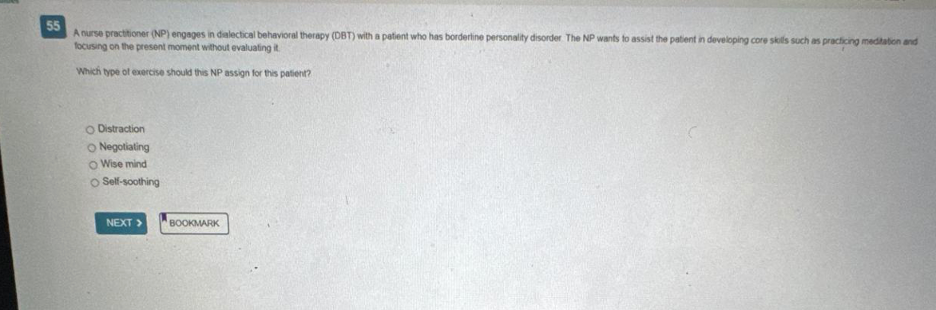
55.
A nurse practitioner (NP) engages in dialectical behavioral therapy (DBT) with a patient who has borderline personality disorder. The NP wants to assist the patient in developing core skills such as practicing meditation and focusing on the present moment without evaluating it.
Which type of exercise should this NP assign for this patient?
- Distraction
- Negotiating
- Wise mind ✅
- Self-soothing………………………………..purchase the 55 questions and answers at $35 only

Reviews
There are no reviews yet.