

BIOS241 Week 8: Exam 3 [Chamberlain]
Question
A child presents with nighttime anal itching and visible worms near the anus. What is the most likely diagnosis?
- Giardiasis
- Norovirus
- Salmonellosis
- Enterobiasis ✅
Question
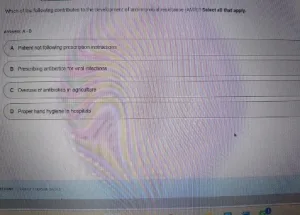
What practices help reduce the spread of antimicrobial resistance in healthcare settings? Select all that apply.
- Isolating patients with resistant infections ✅
- Ensuring proper hand hygiene among staff ✅
- Implementing strict infection control protocols ✅
- Prescribing antibiotics for all fevers
Question
Which of the following factors influences the effectiveness of an antimicrobial agent? Select all that apply.
- Time of day
- Presence of organic matter ✅
- Temperature ✅
- pH ✅
- Color of the surface
Question
What is the role of microbial antagonism in the gut?
- It allows viruses to colonize the intestinal tract
- It increases the growth of harmful bacteria
- It eliminates all microbes from the digestive system
- It allows beneficial microbes to outcompete harmful ones ✅
Question
A nurse uses an alcohol pad to clean a patient’s skin before an injection. This is an example of:
- Degermation ✅
- Sanitization
- Disinfection
- Sterilization
Prion diseases like variant Creutzfeldt-Jakob Disease (vCJD) and protozoan infections like toxoplasmosis differ in their causative agents. Prions are ① misfolded ✅ proteins that lack nucleic acids, while protozoa are ② unicellular ✅ eukaryotic organisms. vCJD is transmitted through consumption of contaminated ③ beef ✅, whereas toxoplasmosis is often acquired through exposure to ④ cat feces ✅ or undercooked meat. Neurological symptoms are common in both, but prion diseases are always ⑤ fatal ✅, while toxoplasmosis may be asymptomatic in healthy individuals.
Answers 1–5
- misfolded ✅
- unicellular ✅
- beef ✅
- cat feces ✅
- fatal ✅……………………………………..purchase this entire exam at $50 only

Reviews
There are no reviews yet.