
NR509 Week 3: iHuman Amanda Wheaton
Case Instructions
CASE PLAY INSTRUCTIONS AND HELP
Rate Page
History:
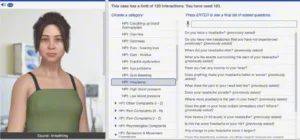
- You may ask up to 120 questions but must determine relevant questions. Questions should be focused on the present illness and associated body systems. More questions do not earn more credit.
- All documentation MUST be completed in the Electronic Health Record (ER) within the iHuman Virtual Patient Encounter.
- Findings do not auto-populate in the EHR.
- Document information in the appropriate EHR sections of the patient history and enter abnormal findings under Key Findings.
- Document subjective information ONLY in the history.
- Suggested approach:
- Start by asking two open-ended questions: “How can I help you today?” and “Any other symptoms or concerns?”
- Next, obtain an HPI. Practice using the OLDCARTS method of documenting the HPI.
- Obtain previous medical history, family history, social history, and review of systems. Document as appropriate within the EHR in the platform.
Physical Exam:
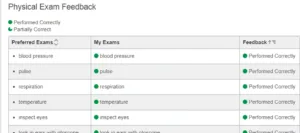
- Open and view the patient’s record to receive credit for obtaining vital signs.
- Click on appropriate physical exams of the present illness and associated body systems to determine findings for the patient.
- Document physical exam information in the EHR in the appropriate sections of the Physical Examination and enter abnormal findings under Key Findings. All documentation MUST be completed in the EHR within the iHuman Virtual Patient Encounter.
- Document objective information ONLY in the Physical Exam.
- Avoid ambiguous terms like “normal”. What is normal? Document what you found; interpret the findings later when you begin diagnosing the findings.
Case authored by: i-Human Patients Academic Content Team
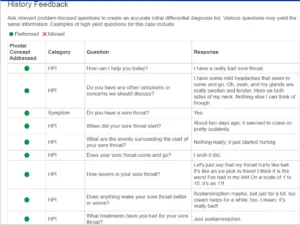
This case has a limit of 120 interactions.
|
Choose a category: |
Or, ask a question. Complete questions work best. |
|
Interview Opening |
|
|
Patient-Centered Responses |
|
|
• HPI: Constitutional Complaints |
How can I help you today? Do you have any other symptoms or concerns we should discuss? |
|
• HPI: Other Complaints (A – H) |
What symptom is the most distressing for you? |
|
• HPI: Other Complaints (I – Z) |
Has anyone else you know developed these symptoms? |
|
• HPI: Pain Complaints (A- H) |
Tell me how that makes you feel. |
|
• HPI: Pain Complaints (I – Z) |
How does this affect your life? |
|
• HPI: Psychological Complaints |
What is your name? |
|
HPI: Sensation & Movement |
How would you like to be addressed? |
|
Complaints |
Where are you? |
|
• Past Medical History (PMH) |
What time is it? |
|
Family Medical History (FH) |
What happened? |
|
• Social Hx (SH) |
Is there anything I can do for you right now? |
|
• Review of Systems (ROS) |
|
Diagnosis Feedback
Pharyngitis, group A streptococcal
The rapid strep test is positive and Centor criteria are highly suggestive of streptococcal pharyngitis. Bacterial pharyngitis is pically caused by direct infection of the pharyngeal tissue by group A Streptococcus, which triggers an inflammatory response.
Interleukins 1 and 6, tissue necrosis factor, and prostaglandins cause fever. Prostaglandins and bradykinin cause pain.
Prostaglandins and nitric oxide cause vasodilation and edema, manifesting as erythema and swelling of the soft palate and tonsillar pillars. The pustular nature of group A Streptococcus infection combined with localized tissue damage causes the characteristic creamy exudate from the tonsillar pillars. Since the pharynx is drained primarily by the anterior cervical nodes, these nodes can become tender and enlarged during a group A Streptococcus infection.
Classic presenting symptoms are:
- Fever
- Sore throat
- Lack of cough
- Cervical lymphadenopathy…………………………………..purchase this ihuman simulation at $25 only
Reviews
There are no reviews yet.