
NR509 Week 4: Midterm Exam [Sept-2026]



The NP is conducting a cardiac physical examination to assess for jugular venous distention. What is the MOST appropriate position for this assessment?
Answers: A – D
- Prone
- Sitting leaning forward after full exhalation
- Supine with head of bed elevated to 30 degrees ✅
- Left lateral decubitus
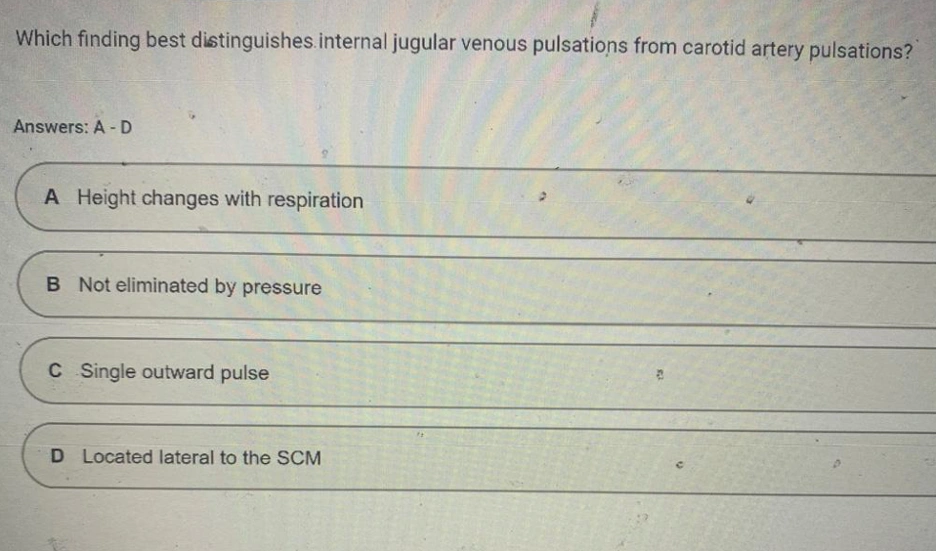
Which of the following findings constitutes jugular venous distention (JVD) during a physical examination?
Answers: A – D
- Internal jugular vein distention observed above 3 cm from the sternal angle with the head of the bed elevated to 30–45 degrees ✅
- Visible pulsations of the internal jugular vein at the sternal notch with the patient seated upright at 90 degrees
- External jugular vein collapse when the patient is positioned at a 45-degree angle
- Carotid artery pulsation visible just above the clavicle with the patient lying flat
During a physical examination of a patient, the NP notes a large, well-defined, flat-topped lesion on the elbow. The lesion is raised and measures about 2 cm in diameter, and it appears to have formed by the coalescence of smaller, elevated spots. How should the NP describe this lesion based on the physical exam findings?
Answers: A – D
- Papule
- Nodule
- Plaque ✅
- Macule
A 44-year-old female presents for follow-up care. She was diagnosed with systemic lupus erythematosus 6 months ago. Since her diagnosis, she has been minimally compliant with medications. The NP is using the FIFE model to guide the encounter. What does FIFE stand for?
Answers: A – D
- Function, Illness, Family, and Examination
- Feelings, Investigation, Findings, and Education
- Feelings, Ideas, Function, and Expectations ✅
- Fear, Impact, Facts, and Evaluation
When evaluating pulsus paradoxus, which measurement difference confirms the finding?
Answers: A – D
- ≥10 mm Hg drop during inspiration ✅
- ≥5 mm Hg drop during inspiration
- Constant systolic pressure throughout the cycle
- Increase in diastolic pressure during expiration
A 42-year-old male complains of pain in his left leg. He does not remember injuring his leg; however, he notes that there is a small wound on the lateral aspect of his mid-shin. Upon examination, some mild erythema surrounding the wound and flat, nonpalpable red streaks progressing up his leg are noted. What do these streaks likely represent?
Answers: A – D
- Dilated veins
- Occluded arterial vessels
- Draining lymphatic channels ✅
- Thrombus
Which of the following best reflects the practice of cultural humility in clinical encounters?
Answers: A – D
- Using your personal experience to guide the patient toward the best medical decision
- Prioritizing biomedical knowledge over a patient’s personal beliefs when conflicts arise
- Learning the health beliefs and customs of every cultural group before clinical practice
- Engaging in self-reflection and respectful communication to build collaborative partnerships with patients ✅…………………………………………………..purchase the entire exam questions and answers at $75 only
Reviews
There are no reviews yet.